Enterprise UX · Product Strategy · Team Leadership
Teck Coal Supply Chain Optimization
A suite of planning tools for a billion-dollar supply chain
Teck’s coal supply chain is a vast, continuous cycle of forecasting, planning, and optimization spanning mine to port. Getting it wrong has enormous cost implications—misaligned train and vessel schedules alone can run into the millions.
I joined as a sole UX Designer to lead the design of a suite of digital planning tools, and grew into a Staff UX Designer leading a team of three across three cross-functional agile product teams.
Billion-dollar decisions made in disconnected spreadsheets
Supply chain planners were making billion-dollar decisions using disconnected spreadsheets, siloed data, and informal communication. There was no unified digital tool for managing the interdependencies between mined coal, blending, train scheduling, port stockpiles, and vessel arrivals.
The cognitive load on planners was extreme, errors were frequent, and decisions were reactive rather than proactive. The business had identified the opportunity for a dedicated supply chain platform, and I was brought in to lead the user experience from the ground up.
Domain experts with limited digital tool experience
Primary users were supply chain planners, operations managers, and data scientists at Teck’s coal operations—including people working at mine sites in the BC interior. Many had deep domain expertise but limited digital tool experience.
Secondary users included executive stakeholders who needed high-level visibility and reporting to support strategic decisions.
From sole designer to Staff UX leading three teams
I started as sole UX Designer, grew to Senior UX, and ultimately to Staff UX Designer leading two junior designers and a co-op. Responsibilities included: strategic and product planning, user research, prototyping and user testing across all three products (short-, mid-, and long-range planning), design system and component library, dual-track design and development delivery process, and full UX integration into Agile ceremonies.
3+ years · 3 cross-functional product teams · 30+ person department. Significant NDA constraints mean specific UI deliverables cannot be shown publicly.
Field research to dual-track delivery
01
Discovery & Field Research
Visited mine sites in the BC interior to observe planners in their natural environment. Conducted a service safari through end-to-end operations. Led dozens of contextual interviews.
02
Mapping the Ecosystem
Built detailed empathy maps, user personas, journey maps, system flows, and a service blueprint revealing the connections—and gaps—between 5+ teams and processes.
03
Alignment & Strategy
Set up meeting cadences across Product Owners, Business Analysts, Deployment Specialists, Value Delivery Managers, and 30+ business stakeholders. Facilitated shared long-term vision across all three products.
04
Dual-Track Delivery
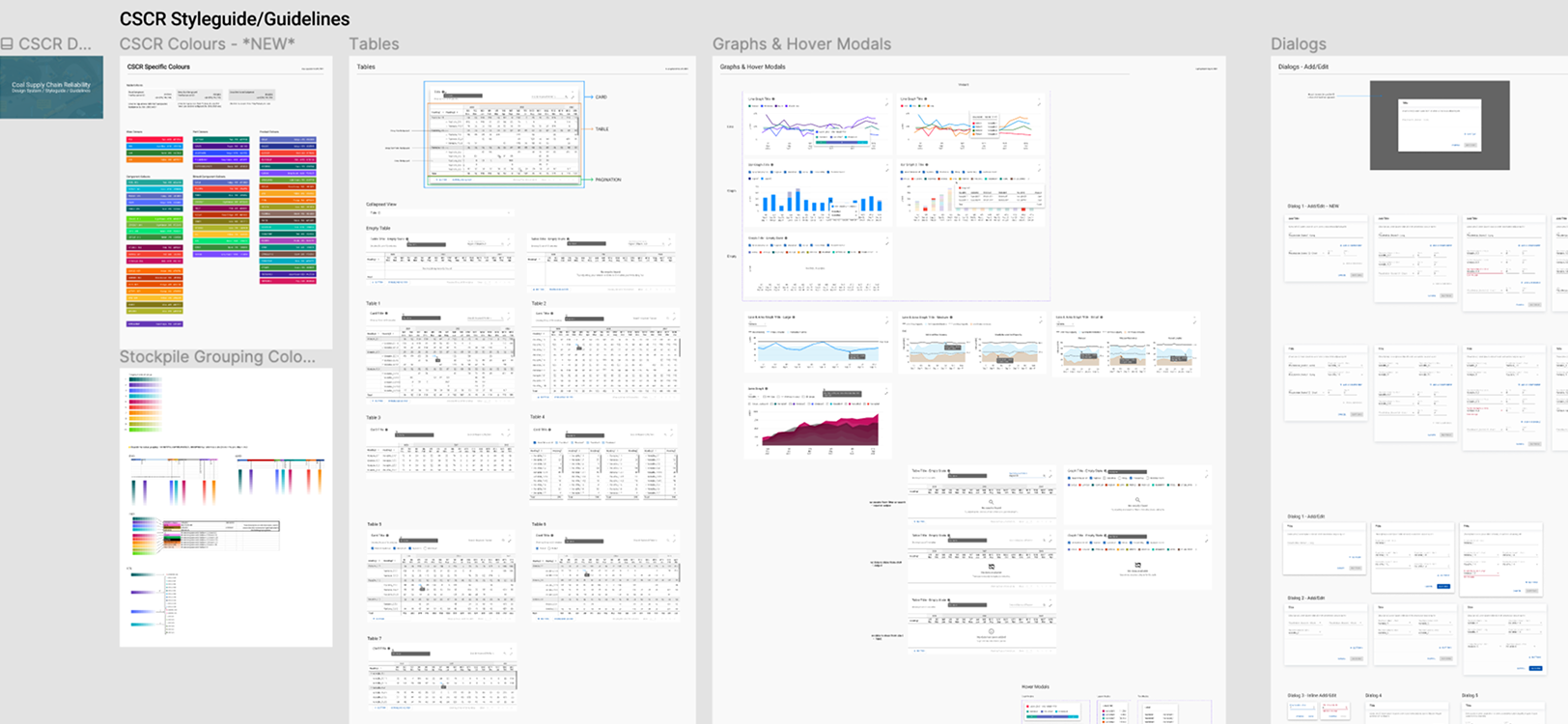
Established dual-track design and development process: design team stayed 1–2 sprints ahead of development at all times. Created documentation, style guide, pattern library, and component behaviour specs.
05
Iterative Prototyping
Continuous cycle of low-fi wireframes, feedback, high-fi prototypes, user testing, and iteration. Worked closely with Data Scientists and Data Engineers to ensure designs were technically feasible and data-accurate.
06
Testing & Refinement
Ran structured usability testing and user sessions with planners. QA and Deployment Specialists joined testing. Every release was measured against user feedback and adoption metrics.
The planners who used these tools were making decisions that affected thousands of jobs and billions in revenue. Getting the UX right was not a nice-to-have—it was mission-critical.
From one team to an enterprise UX practice
3×
Growth from 1 product team to 3 cross-functional teams
30+
People across the CSCR department at peak
1–2
Sprints design consistently led development
The biggest lesson: deep domain expertise on the user’s side demands equal depth from the designer. I invested heavily in understanding coal blending, vessel scheduling, and supply chain economics—not to become an expert, but to earn credibility and ask better questions. UX without domain knowledge in this context produces solutions that are beautiful but unusable.